
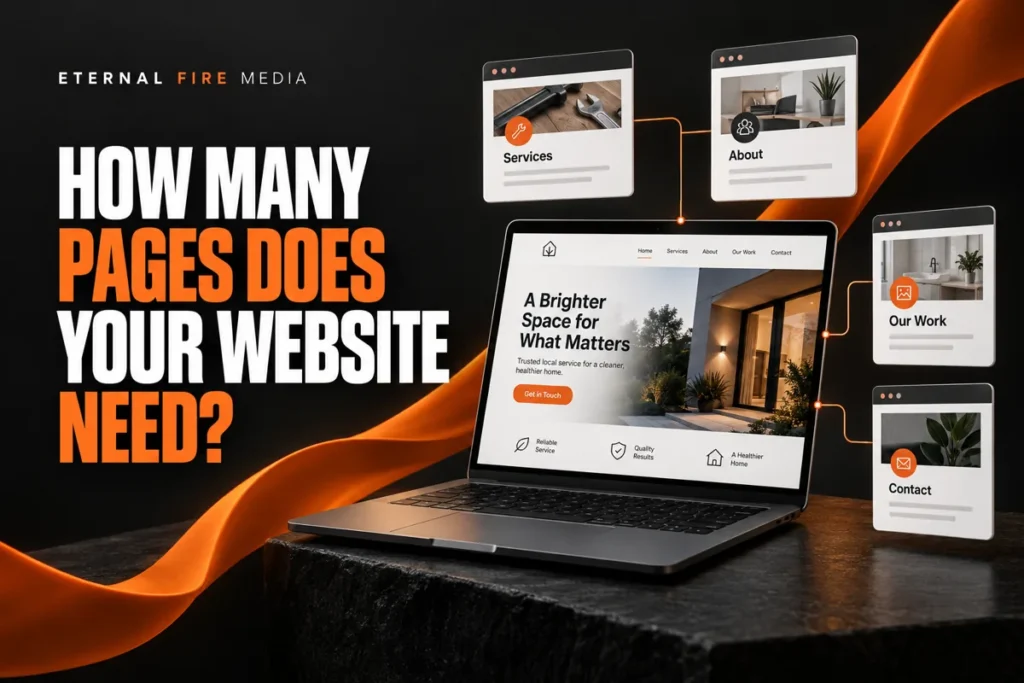

For many small service businesses, five to ten well-planned pages are a useful starting point. That’s a planning range, not an SEO rule or a package everyone needs to buy. A business with one clear service may need fewer pages. A company with several services, audiences, or locations it actually serves may need more.
When I plan a website, I don’t start by trying to sell someone a page count. I start with what their customers need to understand before they feel comfortable calling. The pages should follow from those questions.
Start with these five jobs your website needs to do
A visitor should be able to understand the business, find the right service, see a reason to trust you, learn who they will be working with, and get in touch. A simple starting structure is:
- Home: explain what you do, who you help, and where to go next.
- Services: help people find the service that matches their problem.
- About: introduce the people behind the business and explain how you work.
- Projects or client stories: show relevant work and what was involved.
- Contact: make the next step obvious and easy.
That list is a starting point, not a requirement to squeeze everything into five pages. An overview of your services may lead to several individual service pages. Your business may also need privacy information, other policy pages, booking information, or resources specific to your customers.
Give different services enough room to make sense
If you offer interior painting, exterior painting, and cabinet painting, someone looking for cabinets shouldn’t have to dig through a short paragraph that mentions all three. A dedicated page can explain the process, preparation, suitable projects, examples, and how to request an estimate.
On the other hand, you don’t need a separate page for every small task that is part of the same service. If two proposed pages would say almost exactly the same thing, they may work better together.
On our own website, web design, website management, and hosting have different pages because they answer different questions. Someone who needs a new website has different concerns from someone who likes their current site but needs help maintaining it.
Here is a practical eight-page example
Imagine a local service business with three main services and completed work it can show. Its initial website might include a home page, an about page, three service pages, a projects overview, one detailed project story, and a contact page. That’s eight useful pages before any policy pages.
Each page has a purpose. The home page helps people get their bearings. The service pages explain the work. The project story gives them something concrete to judge. The contact page turns interest into a conversation.
This is an example for planning, not a claim that eight pages will produce a particular number of leads. The quality of the content, the offer, the traffic, and the follow-up all matter.
Add proof before adding filler
If you have the choice between another generic article and a useful account of a project you completed, I would usually start with the project. Explain what the customer needed, what you did, and what you can honestly show about the outcome.
We use client stories for that reason. They let someone look beyond a screenshot and understand the work. Our Viera Painters story, for example, covers our website and ongoing marketing relationship. A story should be specific without inventing impressive numbers just to fill a results box.
What about pages for every city you serve?
For a Brevard County business, it can be helpful to explain where you work. That doesn’t automatically mean you need a separate page for every town.
A city page earns its place when you can make it useful: relevant projects, local client examples you have permission to discuss, practical service information, or questions customers in that area ask. If all you can change is the city name, a clear service-area overview may be the better starting point.
Also be honest about the difference between serving an area and having an office there. A website shouldn’t imply a physical location that doesn’t exist. You can see how we organize our coverage on the areas we serve page.
More pages do not automatically mean better SEO
A bigger site gives you more to maintain. It doesn’t automatically make the information better. Google recommends organizing content logically, writing useful content for readers, and using descriptive links so people and search engines can understand the site. Google’s SEO Starter Guide is a useful reference for those fundamentals.
Before adding a page, ask: does this answer a different question? Is there enough useful information for it to stand on its own? Where will visitors find it? What should they do after reading it? If those answers aren’t clear, the next step may be improving a page you already have.
Why I like WordPress for starting small
You don’t have to build your entire future website at once. With a well-planned WordPress site, we can begin with the pages that matter most, then add useful service information, articles, and client stories as the business develops.
The important part is keeping the structure understandable. New content should fit into the navigation and link naturally to related information. A pile of disconnected pages isn’t much help to a customer.
Let’s plan the pages your customers actually need
Bring me your main services, the questions people ask before hiring you, and a few examples of your work. We can turn that into a practical page plan and decide what belongs in the first version of the site. Talk with me about your website.