
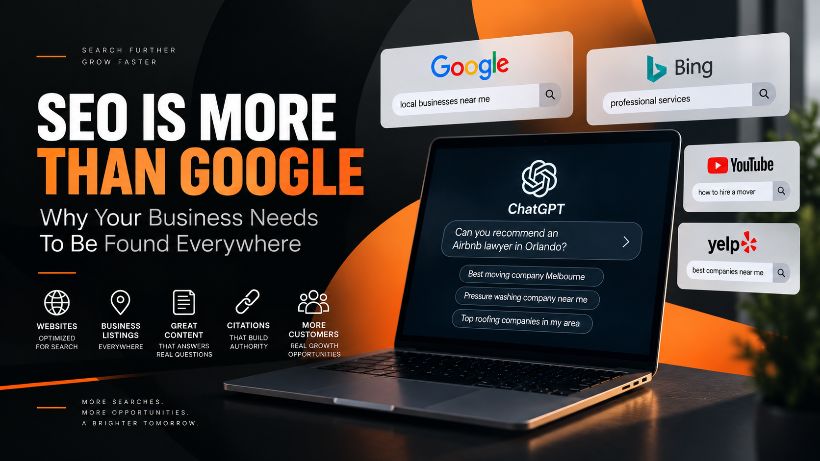

When most business owners hear the term SEO, they immediately think of Google. And understandably so. Google has dominated online search for years, and ranking well on Google remains incredibly important for businesses.
But there’s something we think is worth clarifying.
SEO stands for Search Engine Optimization, not Google Engine Optimization.
At Eternal Fire Media, we’ve always approached SEO with that distinction in mind. Our goal isn’t simply to get your website to appear higher on Google. It’s to help search engines understand your business, recognize its relevance, and make your information accessible to potential customers wherever they’re searching.
And today, that includes more places than ever before.
What Exactly Is a Search Engine?
A search engine is a system designed to help people find information. Traditionally, that meant visiting Google, Bing, or Yahoo, typing in a question, and receiving a list of websites that might have the answer.
Search engines generally work by discovering information, organizing it, and determining which results are most relevant to a particular search.
While every platform has its own methods, traditional search engines consider a variety of factors, including:
- Relevance: Does the content actually answer what someone is searching for?
- Website quality: Is the website useful, accessible, organized, and technically functional?
- Authority and credibility: Are there trustworthy signals supporting the business or information?
- Location: Is the business relevant to the geographic area being searched?
- Content quality: Does the website provide helpful, original information that addresses the customer’s needs?
- Consistency: Is the business information accurate across its website, business profiles, and other online sources?
The exact algorithms used by search engines aren’t publicly available in their entirety, and they change regularly. However, published search documentation, industry research, and our experience provide valuable insight into how these systems evaluate information.
And increasingly, search isn’t limited to traditional search engines.
ChatGPT Is Changing How People Search for Businesses
Think about how you might have searched for a business five years ago.
You probably opened Google, entered a few keywords, looked through the results, visited several websites, and decided which company to contact.
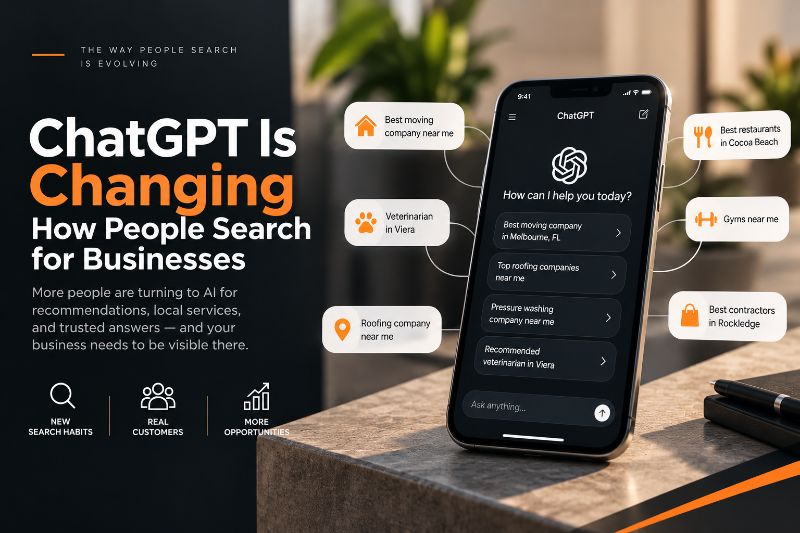
Today, people are also turning to AI platforms like ChatGPT to help with that process.
Instead of searching through multiple websites, someone might simply ask:
- “Can you recommend an Airbnb lawyer in Orlando?”
- “What’s a good pressure washing company near me?”
- “Who is the best moving company in Melbourne, Florida?”
- “Which roofing companies have good reviews in my area?”
These are real examples of the types of searches people make when they’re looking for businesses and services.
And the adoption of AI-assisted search is growing.
According to Forrester’s February 2026 Consumer Pulse Survey, 26% of U.S. online adults reported using ChatGPT to search for products they were interested in purchasing during the previous month. That’s an increase from 19% in October 2025.
Source: Forrester – U.S. Consumers’ Adoption of Answer Engines for Product Discovery
That statistic specifically measures product searches, not all local business or service searches. Nevertheless, it demonstrates that consumers are increasingly comfortable using AI to research purchasing decisions.
We’re seeing evidence of this ourselves.
At Eternal Fire Media, we’ve had clients receive leads from people who found their businesses through ChatGPT. And we’ve seen those opportunities become more frequent.
For us, this isn’t just a conversation about what AI might do in the future. It’s something we’re already seeing happen.
Does That Mean Google Is Losing Traffic?
Not necessarily. And this is where we think some of the conversations surrounding AI and SEO have become misleading.
You may have seen posts on LinkedIn or elsewhere suggesting that Google is dying, traditional SEO is becoming irrelevant, or every business needs to abandon its current strategy and focus entirely on AI.
We don’t agree with that assessment.
In fact, Google reported more than 5 trillion annual searches in 2025. In July 2026, Google also reported that Search usage continued to grow, with AI features contributing to additional search activity.
Source: Google – Q2 2026 Search Update
It’s important to distinguish between search volume, website clicks, and market share. Those are different measurements, and an increase in one doesn’t necessarily mean an increase in another.
What we’re seeing is that people have more ways to find information than they did before.
Someone might use Google to find a business today, ask ChatGPT for a recommendation tomorrow, and use Bing or another platform next week.
The opportunity isn’t about choosing between Google and AI. It’s about making sure your business can be found through both.
How Does ChatGPT Decide Which Businesses to Recommend?
This is one of the most common questions surrounding AI search.
The answer is that nobody outside the companies developing these systems knows every detail of how their recommendations are generated.
And anyone promising to guarantee that ChatGPT will recommend your business should be approached with caution.
AI systems don’t all work the same way traditional search engines do.
Depending on the platform and the question, an AI system may use information learned during training, perform a live web search, consult external sources, or combine multiple methods to generate an answer.
When live search is involved, the system may consider websites, business listings, reviews, directories, articles, and other accessible information.
For example, if someone asks ChatGPT to recommend a moving company in Melbourne, Florida, it may look for information that helps determine which businesses are relevant to that request.
That could include whether a company serves Melbourne, offers residential moving services, has a well-organized website, and appears in reputable third-party sources.
This doesn’t mean any one of those factors guarantees a recommendation. It means businesses benefit from making accurate, useful information available across the internet.
And that’s where good SEO becomes especially valuable.
Why Traditional SEO Work Matters for AI Search
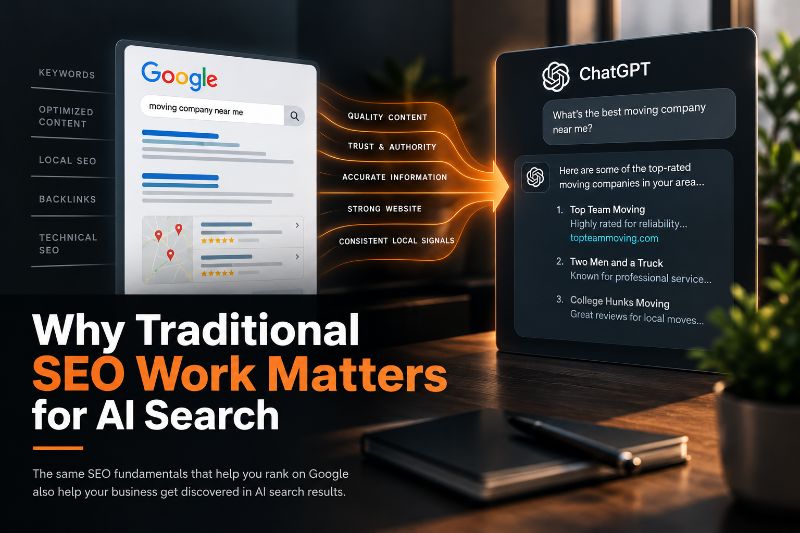
At Eternal Fire Media, the work we do to improve a company’s online visibility goes well beyond adding keywords to a website.
Our SEO strategies focus on helping search engines and customers find, understand, and trust the information a business provides.
Here’s what that looks like in practice.
1. Building Websites That Are Easy to Understand
A well-designed website needs to do more than look good.
We organize websites with clear page structures, descriptive headings, relevant content, logical navigation, and internal links that connect related information.
We also work on technical SEO, including crawlability, indexing, mobile usability, page performance, and structured data when appropriate.
These improvements help traditional search engines access and interpret website content. They can also make information easier for AI-powered search systems to retrieve and reference.
2. Creating Valuable, Relevant Content
We don’t believe in publishing content simply to have more pages on a website.
We want the content to serve a purpose.
That means creating informative service pages, location-specific content, helpful blog articles, and answers to questions potential customers are actually asking.
For example, a moving company shouldn’t just have a homepage that says it provides moving services.
Its website should clearly explain the types of moves it handles, the communities it serves, what customers can expect, and what makes its services relevant to their needs.
The more clearly a business explains what it does, the easier it becomes for customers and search systems to determine whether it’s a good match.
3. Maintaining Accurate Business Citations
A citation is an online mention of a business, often including its name, address, phone number, website, or other identifying information.
These mentions can appear on business directories, industry websites, local listings, and other online platforms.
We work to maintain consistent, accurate business information across relevant sources.
Why does that matter?
Because conflicting information creates confusion.
If one website has an outdated phone number, another has an old business address, and a third lists services the company no longer offers, customers may have trouble finding reliable information.
Search engines can encounter those same inconsistencies.
Accurate citations help establish a clearer online identity for a business and make its information easier to verify.
4. Optimizing Google Business Profiles
Google Business Profiles remain a major part of local SEO.
We optimize business information, categories, services, descriptions, and other relevant profile details to help businesses improve their visibility in Google Search and Maps.
But there’s an important distinction here.
A Google Business Profile is primarily a Google platform. We wouldn’t claim that optimizing it automatically increases rankings in ChatGPT or every other AI system.
However, maintaining accurate, complete business information contributes to a stronger online presence, especially when that information is consistent with the company’s website and other listings.
5. Using Structured Data to Explain Website Content
Structured data, including Schema.org markup, provides additional context about information on a website.
Depending on the business and page, structured data can help identify information such as business details, services, articles, products, and other relevant content.
Think of it as another way to clearly label information for systems that process website content.
Structured data doesn’t guarantee better rankings or AI recommendations. But properly implemented markup can help supported search engines interpret information more accurately.
6. Building Credibility Across the Internet
Your website shouldn’t be the only place where information about your business exists.
Relevant mentions, legitimate backlinks, industry associations, customer reviews, and references from other reputable websites can help establish your business’s presence online.
We focus on opportunities that make sense for the business rather than collecting links or directory listings simply to increase a number.
A useful mention from a relevant local organization may provide more value than dozens of unrelated listings.
The goal is to build a credible online presence supported by accurate information.
Our SEO Strategy Isn’t Built Around One Search Engine
One of the biggest misconceptions about SEO today is that optimizing for AI requires abandoning everything businesses have been doing for traditional search.
We don’t see it that way.
At Eternal Fire Media, we’ve been considering AI search visibility as part of our SEO approach for more than two years.
That doesn’t mean the strategies have remained unchanged. Search technology continues to evolve, and our work needs to evolve with it.
We follow developments in search, evaluate new tools, monitor performance, and adjust our strategies as we learn more about how people find businesses online.
We also recognize that different platforms may use different sources, signals, and methods to determine which businesses to display.
There’s no single optimization technique that guarantees visibility everywhere.
But there is a practical foundation that benefits businesses regardless of where their customers begin searching:
Make your business information accurate, accessible, organized, consistent, and genuinely useful.
That’s what we work toward.
SEO Should Help Your Business Get Found, Not Just Rank for a Keyword
Rankings are important. We track them, analyze them, and work to improve them.
But rankings aren’t the final objective.
The objective is to connect businesses with potential customers who are looking for their services.
Whether someone finds your business through a traditional Google search, Google Maps, Bing, ChatGPT, or another AI-powered search experience, we want your business to have the strongest possible opportunity to be considered.
That means developing a website that answers real questions, maintaining accurate information across the internet, building relevant content, and continually improving the technical foundation that supports your online visibility.
We don’t just want your business to rank on Google. We want it to be a valuable, relevant, and trustworthy result wherever your customers are searching.
That’s what Search Engine Optimization means to us.
And that’s how we approach SEO at Eternal Fire Media.